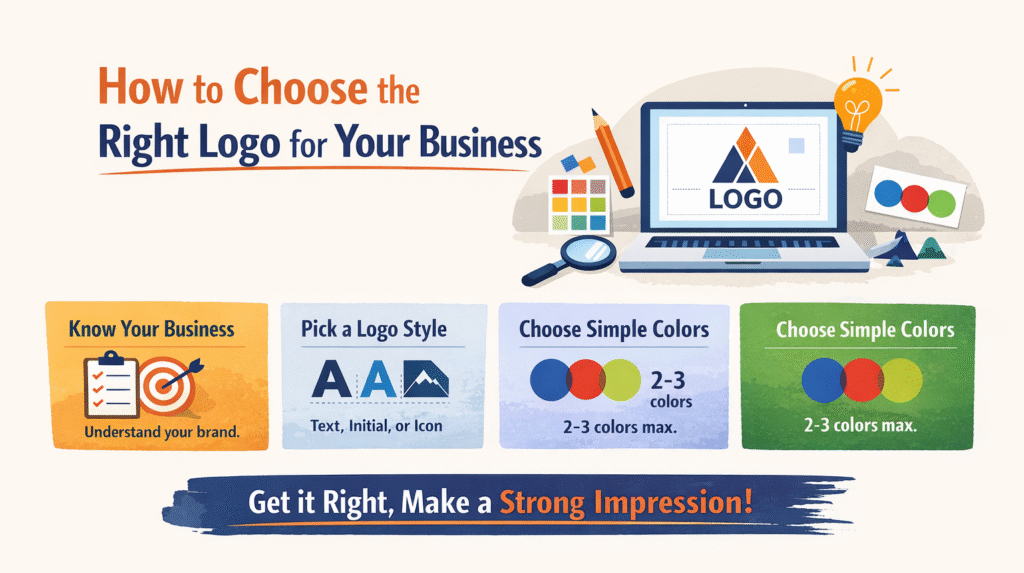
Custom Logo Design vs. AI Logo Creator: Why Custom Design Wins
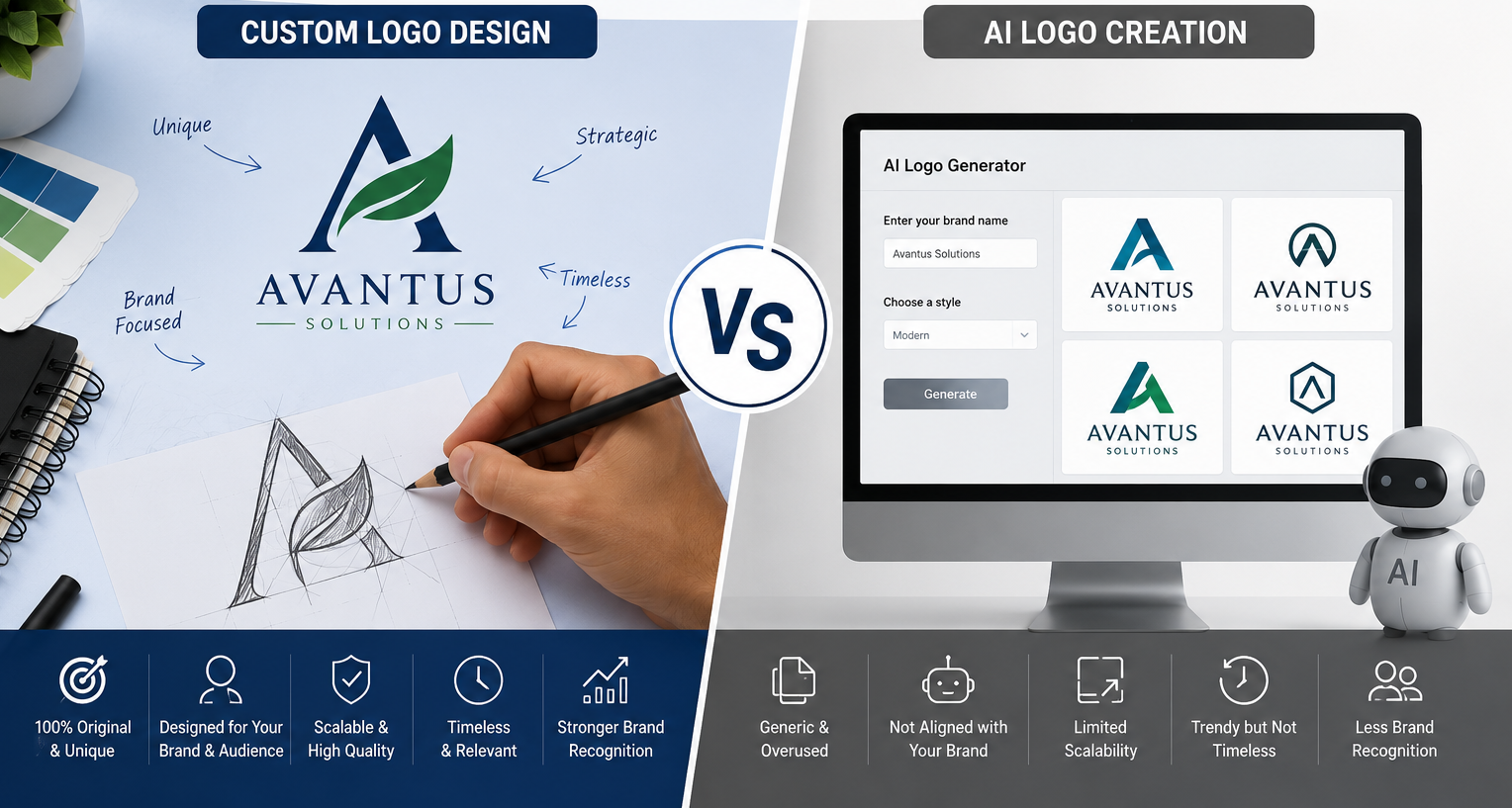
The ability to create a logo in less than a minute for only 10$ might seem like a great offer. After putting in a prompt and pressing a button, you get a nice icon that will do its job on your website perfectly. However, a logo is much more than just an icon. It serves as the foundation of a company’s trademark and brand image.
While AI logo creators can provide you with a prototype in an instant, custom logo design will give you a reputable logo that will stand the test of time. The differences between the two logo creation methods are evident in terms of real-world application, technical implementation, and brand security.
Practical Application: Quick Mockups vs. Strategic Brand Assets
AI tools and human designers have nothing in common.
AI Logo Creation
- When to use: Student projects, presentation mockups, personal use without any budget allocation, and non-commercial samples.
- The down side: AI software uses a database of vectors, templates, and fonts to create an image out of the inputted text. Because the program is generated from millions of users’ requests, the result always looks similar to other AI Logos.
Custom Logo Design
- When to use: Established companies, commercial use, merchandise, and long-term branding.
- The approach: Research + development of the logo styles that would represent the best fit for the company and industry. Unlike AI Logo Creator, every element is selected with a purpose in mind to address a specific goal.
Deliverables & File Formats: The Technical Reality
The deliverable file format offered by many automated logo design tools is also a huge limitation. Your brand needs to be able to print it in a variety of sizes on different materials like clothing, paper business cards, vehicle graphics, and billboards. So you need vector files.
| Feature | AI Logo Tools | Custom Professional Design |
| Primary Formats | Mostly web-only raster files (PNG, JPG), sometimes low-quality SVG | Native scalable vectors (AI, EPS, SVG) plus high-resolution PNG and PDF |
| Color Modes | Screen-only RGB | Print-ready CMYK, digital RGB, and Pantone (PMS) color codes |
| Scalability | Blurs and pixelates when scaled up | Scales infinitely from a small smartwatch screen to a massive building banner |
| Brand Systems | Basic hex codes | Full brand guidelines covering typography, clear space rules, and alternate layouts |
Raster graphic files (PNG, JPG, etc.) are built from pixels, which means that they degrade when they are enlarged. Vector graphic files (AI, EPS, SVG) are made of mathematical equations, which means you can scale them up to any size you want without losing image quality.
Copyright, Trademarks, and Ownership
Ownership determines the ultimate winner in this debate:
- Trademarks: In most jurisdictions, copyright laws do not allow registering computer-generated visuals. AI design services do not offer any protection when it comes to trademarks. This means that your competitors can legally use the same logo as you.
- Stock Vector Scrapes: AI tools are trained on image databases. This means that your icon is most likely to be a modified version of an image that is already licensed by thousands of other companies.
- Legal Protection: A human designer will invent a unique visual concept for your business and then transfer all IP ownership rights to you when handing over the project.
The Verdict: Custom Logo Design Wins
AI logo maker tools allow designing nice graphics fast, but they do not deliver lasting value. Custom logo design offers ownership of a unique visual concept that helps your brand stand out from the crowd by utilizing design excellence and technical precision of vector masters who prepare all visual assets for every possible media type. A custom logo design project can also give you legal protection and establish buyer trust: a professional graphic presentation is often the deciding factor in landing a sale.
Custom logo design investment helps you secure a unique graphic concept for your business that has long-lasting power to represent your brand promise across various media platforms.